
Most people's first week of learning Korean goes like this:
download an app 👉 feel very motivated 👉 do three lessons 👉 feel slightly less motivated 👉 miss one day 👉 feel guilty 👉 uninstall the app. Done.
That is not a personal failing. That is a resource problem.
When you start with the wrong tool, you're not setting yourself up to learn; you're setting yourself up to feel bad about yourself, which is a completely different and much less useful experience.
So let's talk about what your first week should actually look like: structured, honest, and designed for a real human being with a real life who genuinely wants to learn Korean without losing their mind.
Day 1: Meet the Alphabet and Don't Panic
Your only job today is Hangul. Not vocabulary. Not grammar. Just the alphabet.
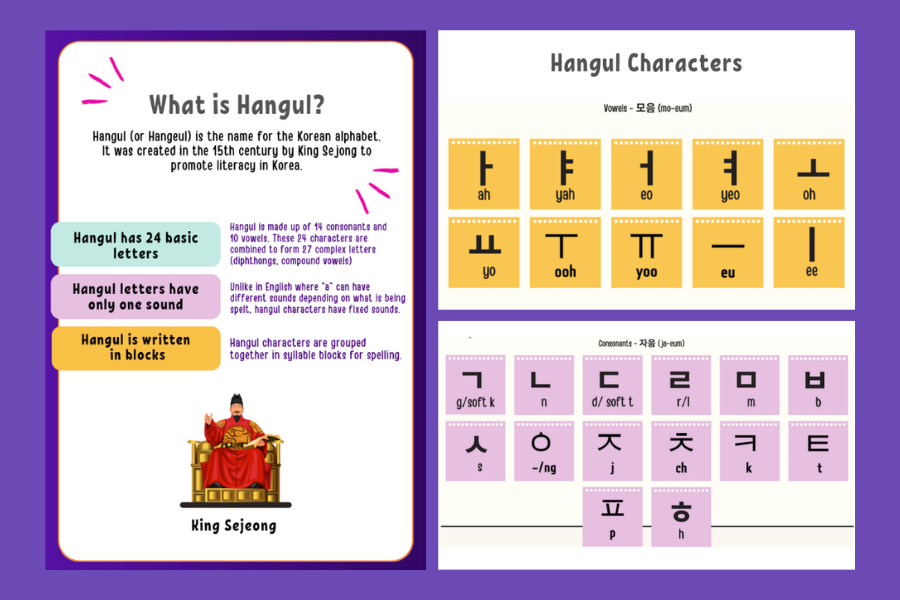
Hangul has 14 consonants and 10 vowels. Each consonant and vowel is a distinct shape, and syllables are built by combining them into blocks. That's basically the whole system.
What you'll notice almost immediately: once you know the shapes, you can start sounding out Korean words. They might not mean anything to you yet — but you can read them. That feeling of 'I can read this' after a single day is genuinely one of the most motivating things a language learner can experience.
End of Day 1: You can read basic Korean syllables. Slowly, maybe awkwardly, but actually.
This is not a drill. People genuinely learn Hangul in an afternoon. The Korean Kickstart Kit walks you through it step by step: it's one of the first things you'll open.
Day 2: Start Connecting the Sounds to Things You Already Know
Today, you do something delightful: you take the Hangul you learned yesterday and start reading words you already know.
언니, 안녕, 진짜, 대박.
You've heard these words in dramas and songs your whole life. Now you can read them. The sound you always heard and the shape on the page click together, and something in your brain reorganises itself quietly and permanently.
This is the moment Korean stops feeling like someone else's language and starts feeling like something you could actually inhabit.
Day 3: Your First 10 Words (Chosen Carefully)
Today, you start building vocabulary. Not all the words from the kit; just 10. Specifically, the 10 that will give you the highest return on your time.
These are words that come up constantly in everyday Korean: greetings, titles, words for common situations. They're the words that, once you have them, make everything else around them make more sense.
Write them down. Say them out loud. Make them a little silly to remember if that helps, since your brain retains things that made it feel something.
Day 4: Open Your Mouth (Even If It Sounds Wrong)
Today is an uncomfortable day. Today, you speak out loud.
Not to anyone if you don't want to. Just to yourself, to your reflection, to the wall. The point is not to sound good. The point is to hear yourself producing Korean sounds and to survive the experience.
Korean has some sounds that feel awkward for English speakers, particularly the distinction between aspirated and unaspirated consonants. The kit has a pronunciation guide for the specific sounds you may find tricky. Use it today.
End of Day 4: Korean sounds weird coming out of your mouth. This is normal. It will stop being weird.
Day 5: Watch Something in Korean Differently
Today, you go back to your comfort zone: a K-drama or K-pop song, but with new ears.
Don't study. Don't pause to analyse. Just watch or listen, and pay attention to any moment when your brain goes: 'Wait. I think I understood something.'
It might be one word. It might be a feeling rather than a specific meaning. But something will land differently, and when it does, you'll understand for the first time what it feels like to be a language learner who is actually learning.

Day 6: Build the Habit
Today isn't about new material. Today is about deciding to keep going.
You've made it five days. That's longer than most people get. The question now is: what does this look like as a real practice rather than a burst of motivation? How many minutes a day can you genuinely commit to? Morning or evening? Alone or with someone?
The learners who stick with Korean aren't the ones with the most time — they're the ones who made a small, sustainable decision about how this fits into their actual life.
Day 7: You Are a Person Who Is Learning Korean
That's it. That's the whole realisation.
You started. You showed up every day. You are not someone who wants to learn Korean someday; you are someone who is learning Korean. Right now. Today.
The Kickstart Kit's 7-day plan carries you through exactly this first week. And when you finish it, there's a next step waiting for you in the form of the Hamkke Korean class for beginners, where we take this foundation and actually build something with it.
But first: the kit. Start with today.
Start Your Day 1 — Download the Free Kit → CLICK HERE
Like Loading...

Author




Leave a comment